
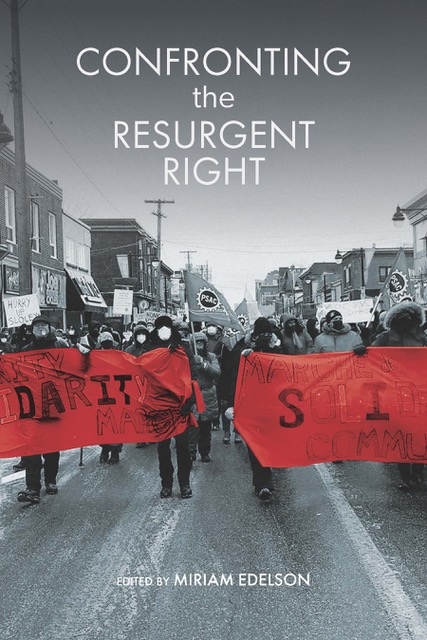
Reprinted from the University of Manitoba Press site. Original article can be accessed here.
“Miriam Edelson discusses the development of her new book, the insights from the contributors and why the subject of resistance to right-wing extremism is so relevant today.”
1. A lot of Canadians are watching the news coming out of the US, as that country is taking a distinctly right-wing authoritarian turn. How does your book speak to our present moment?
“A huge number of people in the US are protesting against ICE and other Trump initiatives. In Canada, we also have a proud history of protest, often coordinated by the labour movement and allied organizations. We are not the US and while many people take solace from that fact, we must not look away from our own challenges in these heady times–for quality healthcare, adequate housing, childcare and education.
There are several indications as to how these extreme right-wing movements have impacted Canadian society negatively. Robert F. Kennedy Jr.’s retrograde public health policy has achieved particular resonance in Alberta. Concurrently, the massive increase in military spending in Canada (to match US demands) is to the detriment of the care economy–housing, health, education and childcare. Women’s rights groups are experiencing greater misogyny and report restrictions in access to reproductive rights. The increase in antisemitic and anti-Muslim actions are also a testimony to a worldview that is deeply entrenched in right-wing ideology. This book presents different perspectives on pathways of resistance that communities can undertake. Hopefully it will spark further conversation toward fostering and protecting social justice.”
2. For this book, you reached out to other researchers who provided insights into the rise of far-right politics in Canada. Can you describe the process of finding other contributors on the subject?
“Barbara Perry, who is a Canadian expert on the far-right, had participated in a webinar for the Canadian Research Institute for the Advancement of Women (CRIAW-ICREF) that I helped to organize. She subsequently agreed to write a chapter for this book. I contacted other academics largely through word of mouth. In terms of social movement leaders, I knew some of them personally from my years in the labour movement. In one instance, I sidled up to a labour leader I’d never met [Alex Silas] at the close of a demonstration where he had addressed the crowd. On the fly, I told him about the project and asked if he would write something. The result is a chapter with many practical ideas about how to organize in the workplace and community. Over an eight-month period, there were as many different approaches as there are contributors and I’m delighted with the group that assembled to carry out this project.”
3. Was anything surprising to you about how contributors to the book interpreted the long-term effects of right-wing extremism?
“I wouldn’t say surprising, but I was introduced to new ideas and historical facts. For example, Dan Panneton writes about the role of memes in communications of the far-right. But I knew nothing about Pepe the Frog and the other neo-Nazi memes which have an alarming currency among far-right actors.
Similarly, Peter Smith’s work on racist skinhead organizing in Canada went beyond anything I’d previously imagined.
Tim McCaskell’s chapter provides an original analysis of the different political strains that interplay in the broader organizing 2SLGBTQIA+ movement. Capturing this history is significant for future advocacy.”
4. How do you think communities can organize to create greater unity against far-right extremists, and what do you see as some of the main challenges?
“In the main, communities and their allies are organizing around specific challenges. In her chapter, for example, Emily Quaile recounts organizing a counter-protest at her daughter’s public school when an anti-trans group threatened to descend. Her group received support from labour unions, community groups and allied politicians. In her chapter, Judy Rebick speaks to the importance of working across difference. This means figuring out objectives and identifying what we agree upon and what we don’t. Where there is a basis for unity around certain ideas and goals, we can pull together more successfully against right-wing forces.”